Category: Business

  • Is Your Business Plan Ready?

    I called my college mate, a founder running a Fin Tech company in Chennai, to talk about the EMR SaaS I’m building.

    He asked me to share my business plan. I have never written one before. Few days later, I found myself learning what a business plan is and how to write one.

    Business plan is basically a document that includes the following:

    • What is the problem you’re trying to solve?
    • How does your product or service solves the problem?
    • Targeted market for your product or service
    • TAM, SAM, SOM (Basically, how big is the opportunity, how much of that market can you serve and how much can you realistically win)
    • Go-to-market strategy
    • Financial plan: Investments & monthly operating costs
    • Potential risks

    Writing a business plan helped me think more clearly about what I’m building, who I’m building it for how I intend to make it a business. I could have spent weeks without clarity. But his question forced me to write a business plan.

    Talking to people who’ve walked the path you’re planning to take can be incredibly valuable.

    Go talk to that person.

  • Eight Years In Business. Profits Struggle. What Do You Do To Solve?

    A few days back, an acquaintance called me to talk about his business. Our last conversation was a while ago. I remembered him being in the web and mobile application development business then.

    This time, our conversation revolved around the digital marketing business. His recent work was about creating Instagram reels for local businesses.

    When asked whether he moved away from web and mobile application development, he mentioned that he expanded his list of services.

    The average ticket size was between INR 50,000 – INR 1,00,000 with a profit margin less than 20% and no sales pipeline.

    The Problem

    When asked, “What does your ideal customer look like?”, he mentioned that he didn’t want to restrict his services to specific markets.

    Catering everyone may appear profitable. After all, you want to put all your skillets to use to make money. Sometimes, choosing a market can make you feel like you’re losing money on the table.

    The problem is clear. Pursuing shinier things in the market is novelty. But the trade-off is that you will be seen as a generalist but not a specialist.

    So, How Do You Solve?

    During the early stage of business, it is important to identify who do we want to serve and what do we solve. This is called market specialization (niche selection).

    Find what skills you’re great at, identify a problem worth solving using those skills and serve people who can’t afford to leave it unsolved.

    Let me give you an example. Now, imagine you’re a SaaS founder with funding looking to build your next MVP to be launched in 60 days. Which business would you hire?

    Consider the following positioning:

    (A) Generalist

    We help Business build software.

    (B) Industry Niche

    We help B2B business build software.

    (C) Problem-specific Niche

    We help funded B2B SaaS founders launch their first usable product in six weeks, without hiring a full engineering team. After launch, we provide ongoing product engineering so founders can focus on customers and growth.

    The last positioning clearly tells who do you serve, what do you solve and emphasises a specific problem.

    The way to get high value tickets is to identify the skills you’re great at, finding a problem you can solve using those skills, and serving people who desperately want the problems solved and the willingness to pay.
  • GTM Strategy & GTM Engineering

    1 and 10 posts in LinkedIn would portray terms GTM strategy and/or GTM engineering. This post is my best effort to understand what GTM strategy & GTM engineering is.

    GTM stands for go-to-market. GTM strategy is all about finding the right customers, communicating your value, acquiring them efficiently and building a sustainable business be it products or services.

    “How is this different from traditional marketing?”, might you ask. Marketing is a component of GTM strategy.

    Let us understand with an example. Imagine you are starting an agency offering software development services.

    In traditional marketing way, you would create a website showcasing your services, improve SEO, publish blogs and create Google Ads targeting business.

    With GTM strategy, you would first answer questions like who your target audience is, your ideal customers, their problem, your value proposition, pricing, acquisition channels, sales process, delivery strategy, success metrics, etc.

    Answering the above questions would then help you determine what marketing campaigns to run and to whom.

    GTM engineering is the practice of using software engineering, automation, AI and data to help a business to acquire customers, increase sales and grow revenue.

  • What is A Cohort?

    Cohort is a way of grouping people, projects so one can manage, observe, compare their progress over time.

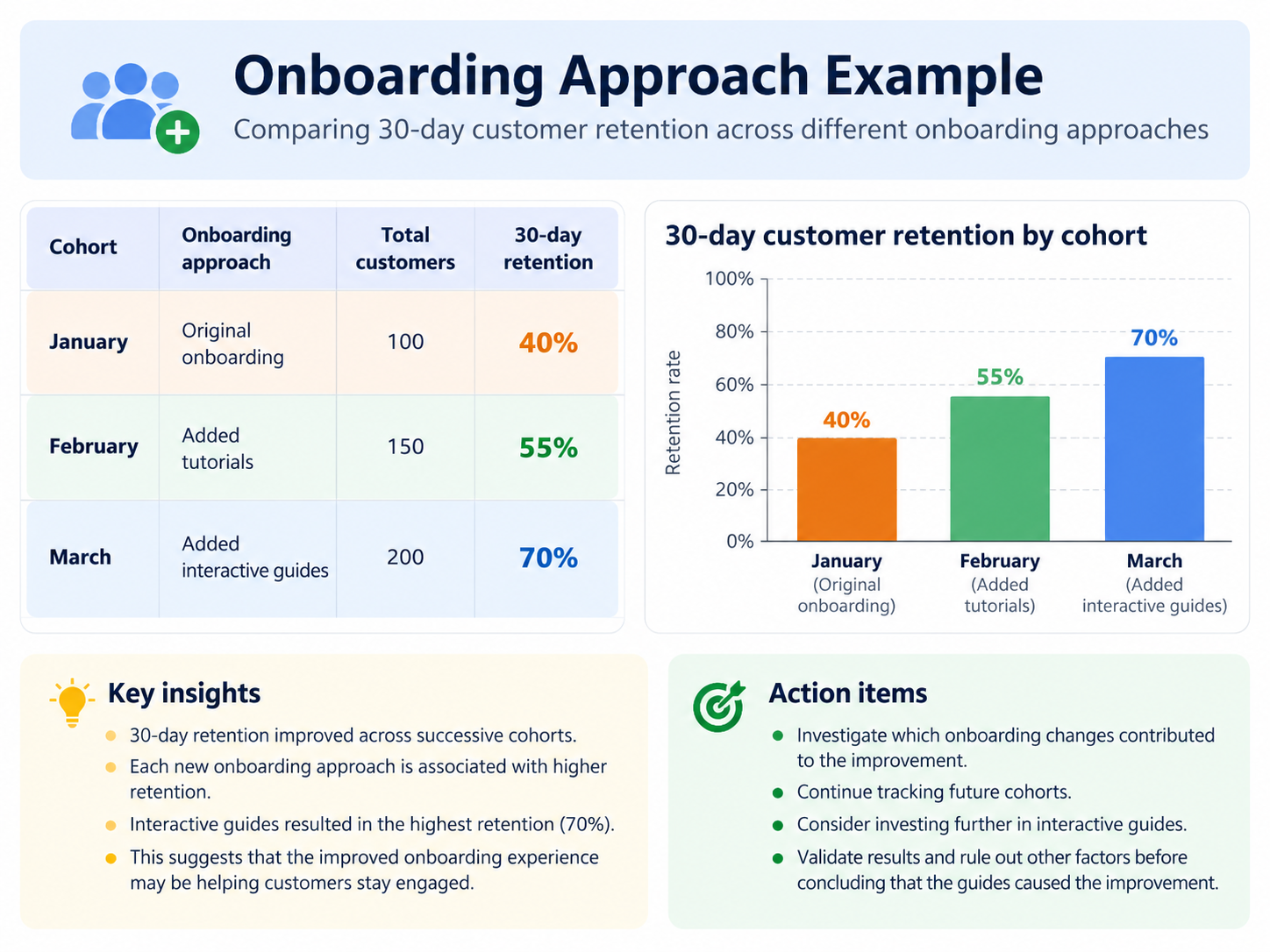
    Imagine this scenario — a SaaS application onboarding customers each month. In this case, a cohort can be customers signing up to the SaaS every month. That may mean 100 customers signing up in January, 150 customers joining in February and 200 customers signing up in March.

    You can then measure how each cohort performs. So, you can track retention, engagement, conversion and feedback, etc.

    Why Is Cohort Important In Project Management?

    Cohorts allow project managers to understand how specific groups perform overtime. Project managers can then measure progress, identify problems early, compare performance, improved decision making and evaluate improvements.

    You can see how cohorts can help improve retention in a SaaS using the chart above.