Tag: Journal

  • Is Your Business Plan Ready?

    I called my college mate, a founder running a Fin Tech company in Chennai, to talk about the EMR SaaS I’m building.

    He asked me to share my business plan. I have never written one before. Few days later, I found myself learning what a business plan is and how to write one.

    Business plan is basically a document that includes the following:

    • What is the problem you’re trying to solve?
    • How does your product or service solves the problem?
    • Targeted market for your product or service
    • TAM, SAM, SOM (Basically, how big is the opportunity, how much of that market can you serve and how much can you realistically win)
    • Go-to-market strategy
    • Financial plan: Investments & monthly operating costs
    • Potential risks

    Writing a business plan helped me think more clearly about what I’m building, who I’m building it for how I intend to make it a business. I could have spent weeks without clarity. But his question forced me to write a business plan.

    Talking to people who’ve walked the path you’re planning to take can be incredibly valuable.

    Go talk to that person.

  • Week 43: Stepping Into SaaS

    Week: Oct 19 to Oct 25, 2026

    A week ago, I shared how a random conversation paved way for a potential SaaS. We had built the working prototype.

    This week, we got a chance to showcase our prototype, to an endocrinologist, in one of the established medical centres in Salem.

    The doctor appreciated our efforts and was happy to see the working prototype. After the demo, I asked for his feedback. He was happy to share his feedback. Every feedback is a valuable insight to improve our software.

    When asked, “How soon would you like to be on-boarded?”, he replied, “As soon as possible.” That little statement fuelled us with more enthusiasm and intention.

    I previously wrote about the experience in the post — The uncomfortable side of building something.

    Jogging

    I was able to jog for 4 days this week. I’m able to now run 1.2 Kms in a stretch since I started jogging.

    Switched To AWS

    This week I moved all my websites to AWS.

  • Sometimes, All It Takes Is a LinkedIn Post

    I found a non-promotional post on LinkedIn that caught my attention. That eventually led me to Arunan and his venture OS Works.

    We had a good conversation and got to know each other.

    I liked how he turned Open source software into a business opportunity. He is running OS Works with a team of just one. If you’re running a small business, his services might be worth exploring.

    I’m truly happy for Arunan and his new venture. Sometimes, all it takes is a LinkedIn post to start a meaningful professional relationship.

  • Moved To Amazon Lightsail

    In my earlier post, I mentioned about moving to Amazon Lightsail along with my reason.

    Today, I finally moved all my websites.

    I did everything from selecting an Lightsail instance, setting it up using Ansible, deploying the websites on to Lightsail including the DNS management all with zero downtime. I’m even leveraging the built-in monitoring feature in Amazon Lightsail.

    I’m really proud of myself.

    Also, I’m fortunate to be alive in this beautiful era where one can compound the knowledge with AI assisted tools like Codex to do more in much less time.

    My buddy, Siddharth, keeps advocating to use OpenLiteSpeed. I never got a chance to try. However, this time, I bit the bullet and switched to using OpenLiteSpeed.

  • Moving To Amazon Lightsail — Predictable Billing

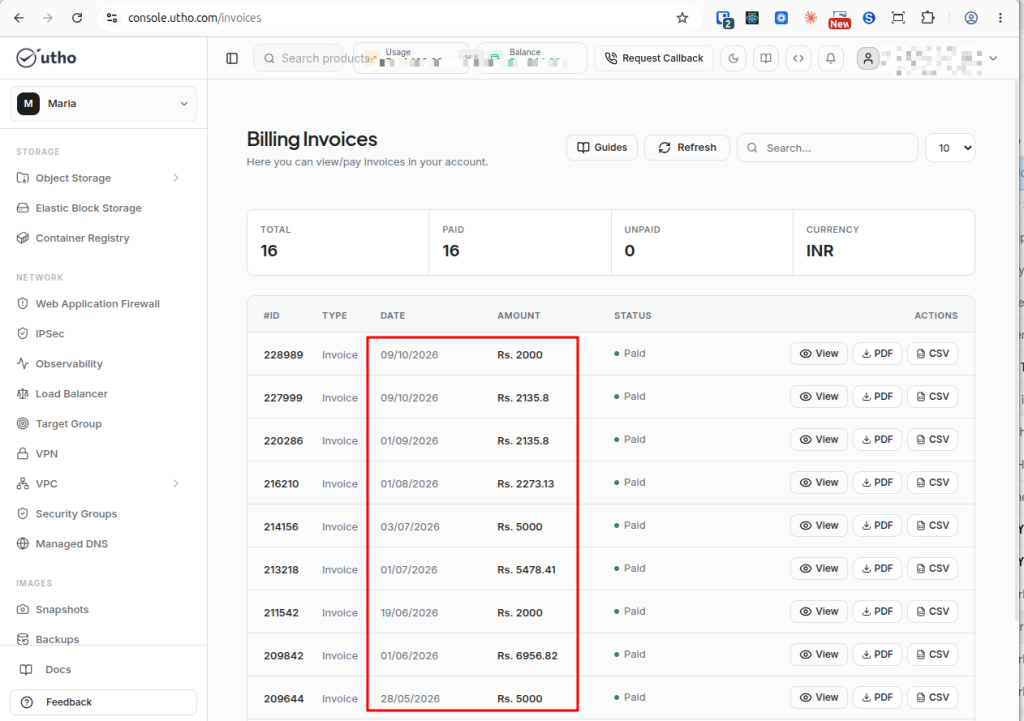
    I found Utho when I was looking for reliable Indian Cloud service providers. I’m impressed with their customer support. They respond quickly and resolve any issues. I had no complaints.

    Earlier this year, I was testing Open Claw, Hermes and a few other applications. Lately I don’t use those applications as much as I used to. There are only a few WordPress instances left in the server.

    I clearly know I spend more than I should for these WordPress websites. So I decided to move. This time, I chose Amazon Lightsail.

    Amazon Lightsail provides virtual private instances that come with predictable billing, same as Droplets, Linode Instances, etc.

    Another reason I wanted to move to AWS is to learn their ecosystem well.

    I developed and hosted MacroIntel.app, a signal-generation application used in production by a macro trader to implement his strategy, turning U.S. macroeconomic releases into Gold (XAU) buy/sell signals, in Amazon EC2 recently. So, understanding their ecosystem makes sense in the long run.

  • The Uncomfortable Side Of Building Something

    Last week, I wrote about how a random conversation turned in to a real product.

    With the working prototype, my schoolmate and I approached a clinic and showcased the EMR prototype to a doctor. Through our discovery questions we realised the actual pain points, and a few ideas to make our EMR even better.

    When we asked the Doctor, “how soon would you like to be on-boarded?”, he replied, “As soon as possible”. He even volunteered to connect us with his known associates.

    We know we took the first step right.

    But later that day, I couldn’t sleep at all. Because I didn’t know if I must celebrate or be concerned. One one end, I must be celebrating for validating the idea and the prototype. One the other end, I’m concerned whether all these efforts will work out in the long run.

    Questions like — “Will we be able to onboard more doctors?”, “What if we’re unable to?” didn’t let me sleep. I don’t have an answer to these questions today. And I don’t know if I will ever have answers to such questions. Maybe, this is how every SaaS is built. Maybe, this is the uncomfortable side of building something, anything.

    But I know this is the game I must be playing. I only remembered the quote by Ellen, The Iron Lady Of Africa —

    If your dreams don’t scare you, they aren’t big enough.

  • Eight Years In Business. Profits Struggle. What Do You Do To Solve?

    A few days back, an acquaintance called me to talk about his business. Our last conversation was a while ago. I remembered him being in the web and mobile application development business then.

    This time, our conversation revolved around the digital marketing business. His recent work was about creating Instagram reels for local businesses.

    When asked whether he moved away from web and mobile application development, he mentioned that he expanded his list of services.

    The average ticket size was between INR 50,000 – INR 1,00,000 with a profit margin less than 20% and no sales pipeline.

    The Problem

    When asked, “What does your ideal customer look like?”, he mentioned that he didn’t want to restrict his services to specific markets.

    Catering everyone may appear profitable. After all, you want to put all your skillets to use to make money. Sometimes, choosing a market can make you feel like you’re losing money on the table.

    The problem is clear. Pursuing shinier things in the market is novelty. But the trade-off is that you will be seen as a generalist but not a specialist.

    So, How Do You Solve?

    During the early stage of business, it is important to identify who do we want to serve and what do we solve. This is called market specialization (niche selection).

    Find what skills you’re great at, identify a problem worth solving using those skills and serve people who can’t afford to leave it unsolved.

    Let me give you an example. Now, imagine you’re a SaaS founder with funding looking to build your next MVP to be launched in 60 days. Which business would you hire?

    Consider the following positioning:

    (A) Generalist

    We help Business build software.

    (B) Industry Niche

    We help B2B business build software.

    (C) Problem-specific Niche

    We help funded B2B SaaS founders launch their first usable product in six weeks, without hiring a full engineering team. After launch, we provide ongoing product engineering so founders can focus on customers and growth.

    The last positioning clearly tells who do you serve, what do you solve and emphasises a specific problem.

    The way to get high value tickets is to identify the skills you’re great at, finding a problem you can solve using those skills, and serving people who desperately want the problems solved and the willingness to pay.
  • Week 42:Jogging, The New Routine

    Week: Oct 12 to Oct 18, 2026

    Jogging

    I started training for Muay Thai recently. Muay Thai demands excellent cardio to begin with. So I started jogging this week.

    I ran for 5 days which I consider excellent for a newbie like me. In the beginning, I couldn’t jog even for 300m. By the third day, I made it to 300m. By the fifth day, I made it to 600m.

    If you’re a newbie like me, aim for consistency before increasing distance.

    Tech Lead: Positioning My Skills

    I positioned my skills aiming for the tech lead role at a company of my liking. I spent good amount of time across two days positioning my skills.

    However, the role expects Vue.js and Laravel. I haven’t worked on these technologies in Production. I have worked on technologies other than the technologies in my day job even before the AI assisted development tools.

    With tools like Codex at my disposal, I don’t see technologies as a limitation. However, companies may or may not see that way. I understand that. So, the company has a good reason not to proceed with my application.

    Update (Oct 26, 2026)

    The company I applied chose someone else whose experience closely aligned with the role.

  • Random Conversation Turned Into A Real Product

    My schoolmate and I were chatting about how a EMR (SaaS) he has been using for a while, felt cluttered.

    The cluttered UI kept popping up in conversations over time. One day, our causal chat turned in to a requirement gathering session in a restaurant.

    I happened to talk a developer friend about the cluttered UI. Sparked by the idea, the developer friend wanted to join hands.

    Four weeks later, the developer friend and I turned the idea in to a working demo. The schoolmate, after seeing the demo, was impressed.

    Now, we’re turning the demo in to reality, talking about compliance auditing and SaaS pricing. We’re all excited to see how things turn out for us. This is quite a learning for all three of us.

    Our story is quite similar to Tokenn which I read in LinkedIn recently.